
Buying a mortuary refrigerator? Compare the installed cost, not just the factory price. For hospitals, funeral homes and morgues, a modular mortuary cold room offers layout flexibility, while a self-contained mortuary refrigerator simplifies installation. Here is how to choose.
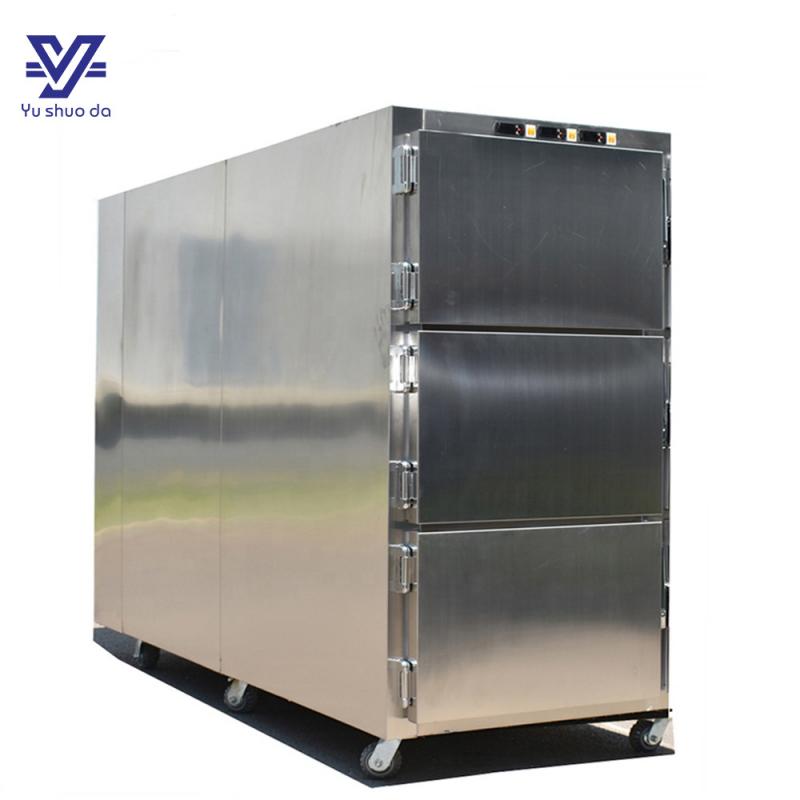
YUSHUODA YS-3 cabinet-style mortuary refrigerator. Configuration is subject to the quotation.
A modular mortuary cold room uses insulated panels assembled on site, with body racks and a matched refrigeration unit. A self-contained mortuary refrigerator arrives as an assembled cabinet with integrated refrigeration. Panel construction does not automatically mean a split refrigeration system: some cold rooms use a packaged monoblock unit.
| Compare | Modular mortuary cold room | Self-contained body refrigerator |
|---|---|---|
| Advantages | Flexible layout; panels can pass through restricted entrances. Expansion may be possible if planned into the design. | Factory assembly reduces site work. Individual compartments support convenient daily access. |
| Limitations | Site workmanship affects insulation and reliability. Expansion requires checking cooling capacity. | Large assembled cabinets need adequate doors, corridors and lifting access; layout changes are limited. |
| Product cost | Can offer lower cost per body at larger capacities; include racks, doors, controls and refrigeration in the quote. | Often economical for smaller installations; multiple independent cooling circuits add components and cost. |
| Transport cost | Panel packing may reduce shipping volume, but racks, crates and refrigeration units still count. | Assembled cabinets usually occupy more volume. Compare actual packed CBM, gross weight and handling charges. |
| Installation cost | Budget for floor preparation, panel sealing, rack assembly, electrical work and commissioning; split systems also require refrigerant pipework. | Usually lower site labour: position, level, provide ventilation and suitable power, then commission according to the manual. |
Modular systems: Poor panel joints or door seals can cause condensation, icing and heat gain. Split systems require skilled leak testing, evacuation, charging and control setup. Agree who handles installation defects and refrigeration faults before ordering.
Integrated morgue refrigerators: Service focuses on condenser cleanliness, airflow, fans, sensors, controllers and compressors. Compact machinery spaces can complicate repairs. Independent chamber circuits can limit a cooling fault to one compartment, but do not eliminate shared power risks.
For either design, request wiring diagrams, troubleshooting videos, spare-part numbers, local refrigerant availability, warranty exclusions and response times. Remote guidance cannot replace a qualified technician for refrigerant or electrical repairs.

Check tray access, door seals and service clearance before choosing a body storage refrigerator.
Compare: equipment + export packing + freight/insurance + destination charges + import duty/taxes + local delivery + installation/commissioning. Then add electricity, maintenance and potential downtime over the same ownership period.
Neither design automatically attracts lower customs duty. Ask a customs broker to confirm the destination-country classification, origin treatment, customs value, duty and VAT/GST. Shipping panels separately does not automatically reduce tax. Compare quotations on the same Incoterm and scope to avoid double-counting freight or omitting local charges.
Which should you choose? Start with a self-contained morgue fridge for straightforward installation and modest capacity. Evaluate a modular cold room for larger capacity or difficult access where qualified installation support is available. Let equivalent specifications and total installed cost decide.
Planning your mortuary refrigeration project? Explore YUSHUODA mortuary refrigerators and freezers. Send your body capacity, target temperature, room dimensions, local power supply and destination port to ala@ysdmedicalequipment.com for a configuration and shipping quotation.
 Послать сообщение
Если .Вы заинтересованы в наших продуктах и хотите узнать больше деталей, пожалуйста, оставьте сообщение здесь, мы ответим вам, как только мы Can.


 Поддерживается сеть IPv6

 русский
 English
 español